This pop novel is a sequel to FM247: This Is Radio Binfield! joint-authored in 2009 with lifelong friend Andrew Worsdale. This sequel is all the hubby’s own work, and is told via the voice of DJ narrator Lugwin Loggins. Admitted to hospital following an acute psychotic episode, he is haunted by a childhood dream about the killing of the Albanian Civil Rights leader, Ramiz F. Kreshnik, and experiences daily the effects of a schizo-affective disorder causinghim to hear voices – including that of his DJ persona ‘The Emperor’. Attempting to unlock the roots of these issues, his doctor prescribes ‘radio therapy’, motivating Lugwin to compile a playlist of one hundred songs; these form the chapter structure of the book, with each song informing Lugwin’s understanding of how his fractured family background has shaped his mental health, as he seeks to transition from hospital to Community Care. Will Lugwin recover, and maintain his mental health? Can he make his dream of public service broadcasting a reality?
Work is already in progress on a prequel rewrite, currently working-titled FM247 On The Air, and you can read more about the man himself here: just pop up the the menu bar and click on ‘Rob Spooner – FM 247.
Meanwhile, my own writing ventures have been (temporarily) side-lined, in favour of family fun, as we’ve had our granddaughter staying with us for the summer. Here she is (together with next door’s cat) ‘modelling’ grandpa’s book, perched on the bench outside in the community garden (which we – ourselves and neighbours, as a collective – have been creating this last couple of years, and which I keep intending to blog about but as yet haven’t – but will – i really will! – be doing very soon).
10.48 PM. Just a few hours since my previous post. Mission accomplished. I attended my first (of what will be many) ‘live session’ of the Memoire writing course, as per today’s previous post. Like a lot of people, this whole Zoom-meet thing is quite new to me … well, not *completely* new, because my MA was by distance learning, studying ‘at’ the University of Wales Trinity Saint David via the magic of modern internet connection. So, not entirely new. But new enough. And then there was lockdown. And now we all have Zoom fatigue. The positives, nevertheless, still outweigh the negatives – most obviously, now, being able to ‘attend’ a course hosted by a tutor in Canada, along with fellow students all around the world, accommodating different time-zones, altogether in cyberspace. Live chat and interaction – plus – bonus! – the whole thing gets recorded, so we can watch it again, whenever, wherever, and however many times we might want or need. A wholly different experience to my undergraduate studies, way back when …
But I digress ….
Topic for the evening was ‘memoire as poetry / poetry as memoire’ with guest speaker Canadian poet and glass artist Kim Mckellar – who, I confess, I had never heard of until now. Here is an example of her work …
Poetry is an art that I myself am yet to master. Yet. If ever. One day (perhaps) I may try. Perhaps. In the meantime, this first session was inspirational, and energising … yet it left me depleted. I’d not known what to expect, found it difficult to stay focussed, and then when it was over I felt fidgety and strangely emotional … Simultaneously flat, weirdly tearful, yet oddly also rested and lifted. Only one thing for it: a hot, deep, bubbly bath. With tea. And chocolate. Waiting for the kettle to boil (for said tea) my gaze followed through the kitchen window to this climbing rose (pictured, below) currently sprawling, in full bloom, up and over the back fence. Framed against a dramatic sky (not yet dark with night, but heavy with impending weather) it somehow matched my mood. The picture does it no justice: poor lighting and insufficient techno-whizzary to make full use of the camera settings. I’ll take another tomorrow. In better light.
I acquired this rose almost exactly five years ago, in the first week of July 2016. It was then very small and scraggly, merely a couple of short stems with a few leaves but a strong root system, bursting to escape the 5-inch pot in which it sat, grasping onto life, in a forgotten corner of my mom’s overgrown back garden. She had died, suddenly, just a few days previous, five weeks short of her 80th birthday. I brought it home and planted it out in my own garden, where it has since grown steadily, extending its reach to fill almost the entire fence, drooping indulgently over into the back alley, all sprawling branches, sharp thorns, and abundant foliage. It flowers every year at this same time, marking the anniversary of her passing with an ever-expanding display of outrageously glorious magenta pink blooms.
It must mean something, I am sure. I just don’t quite (yet) know what.
Well this is exciting. A change from the more usual blog focus on bees, garden growing and health. Last week I enrolled on a creative and nurturing writing course. A memoire-writing course with award-winning Canadian playwright, performer and best-selling author Alison Wearing .
Yes, I know that I just finished an M.A., I have a few projects on the go, and am applying to start a PhD (fingers crossed) this coming autumn. But this is different. A side step from formal academics to more personal endeavours languishing far too long on the back-burner. I am beyond excited, as I’ve been wanting to do this for quite some time (several months, in fact) but I kept putting it off, awaiting that mythical *one day* … you know, the ‘one day’ that never comes …
Well, that ‘one day’ is now here. Result being that, simultaneous to feeling ‘beyond excited’ I am somewhat apprehensive … because of course now there is no excuse. Nowhere to hide. The time is here. The time is now.
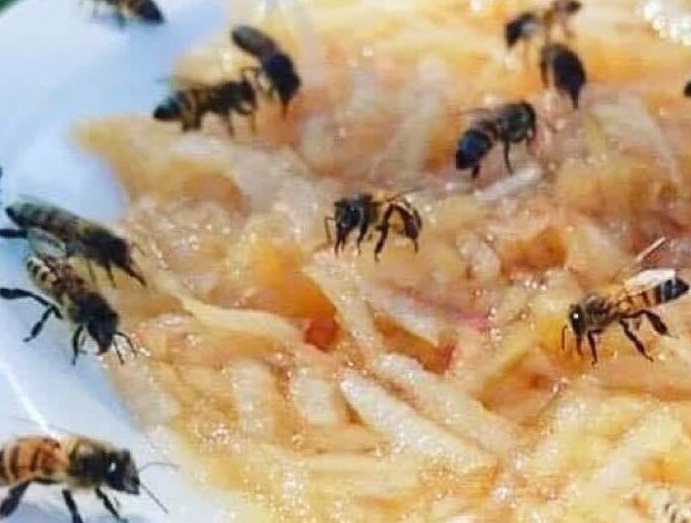
Social media. A double-edged sword. Simultaneous blessing and curse. A great way to keep in touch / A murky swamp of misinformation … including an alarming array of nonsense masquerading as ‘advice’. From the well-worn ‘revive a tired bee with a teaspoon of sugar and/or honey & water’ cliche to this latest meme depicting a plate of grated apple, crawling with badly photoshopped honeybees, as supposed method of ‘supporting’ bees with a ‘natural’ sugar-infused drink. AKA the ‘bee bar’.
Thankfully I am not the only beekeeper screaming out from the keyboard: ‘NO! Please do NOT do this!’ in response to the profusion of enthused: ‘Oh, yes! What a brilliant idea – Yay! Help save the bees!‘
Fortunately, many have responded reasonably – and for the most part, rationally – to the news that putting out sugar/honey/grated fruit as bee food is a bad idea. A really bad idea. But there are those who just will not be told. They just have to be right. And/or they just like to argue … The main issue being the identity of the insects themselves, with a huge number of commentators insisting that they are not bees, but wasps. Because wasps are yellow and stripey … and bees are cute ‘n’ fat ‘n’ fluffy … right?!
Wrong. The insects in the meme are absolutely – without a doubt – honeybees. Not so cute, not so fat and nowhere near so fluffy. And yes, to the uninformed, they can look more like wasps than bees.
So, now we have that cleared up, on to the sugar-honey-fruit thing.
Firstly, the ‘revive a tired bee with sugar/honey and water’ trick.
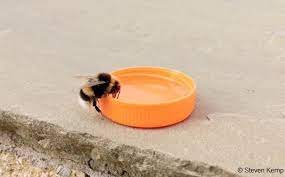
Yes, if you find a bumble bee (cute, fat ‘n’ fluffy) looking tired and depleted, perhaps crawling around on the ground, seemingly unable to fly, it may well be that he/she is tired, thirsty and exhausted, and yes, you can offer an energy boost by mixing sugar and water (equal amounts) on a teaspoon, in a bottle top or even direct onto the ground: the bee will drink and, refreshed and revived, may fly off – giving you that lovely warm fuzzy ‘i saved a bee’ feeling. But …the brutal truth here is that they may be crawling around on the ground not because they are ‘tired’ but because they are injured, ill, or simply old – in which case no amount of sugar/water is going to help them. However, the point here is to only ever use sugar for this. Ordinary, granulated white sugar. Never – NEVER! – feed honey to bumblebees. Why not? For the simple reason that bumblebees do not naturally eat honey. Honey is made by honeybees – not bumblebees. Honey should therefore not be fed to bumblebees. Ever.
Which brings us back to the subject of honeybees. And those grated apples.
First up … to repeat a basic point: honeybees eat honey (which they make from nectar, the sugary juice of flowers which they collect by forage-feeding). They do not eat fruit (the end result of flowers being pollinated by foraging insects – including, erm, bees). Additionally, honeybees have a natural aversion to alcohol … And guess what happens when you mix grated apple with water and leave it lying around … yup, that’s right, it ferments … as in, it turns to alcohol. Meaning, your plate of grated apple in water will not work as food for bees. It will however attract wasps. Lots. Of. Wasps. (footnote: in unusual circumstances – for example, if they are starving and there are no flowers around, then yes, bees will chow down on whatever sugar source is available – including the junk-food options).
So … next obvious idea – what about sugar water?! Yes, I know, this seems like an ideal solution. But again, this is a really bad idea. Why? Well, again, the sugar mixed with water will ferment. Into alcohol. The main reason, however, is that honeybees naturally forage for their own food, collecting pollen (protein) along with nectar (sweet carbohydrate flower-juice) – travelling up to five miles visiting many different flowering plants along the way. They will, however, take the easy option, if there’s such an option available – for example, if there happens to be a container of sugar-water lying around then they will happily rely on that instead.
Which of course prompts the seemingly obvious next-step solution: so, we can leave out honey as bee food … either neat, or mixed with water … right?
Wrong.
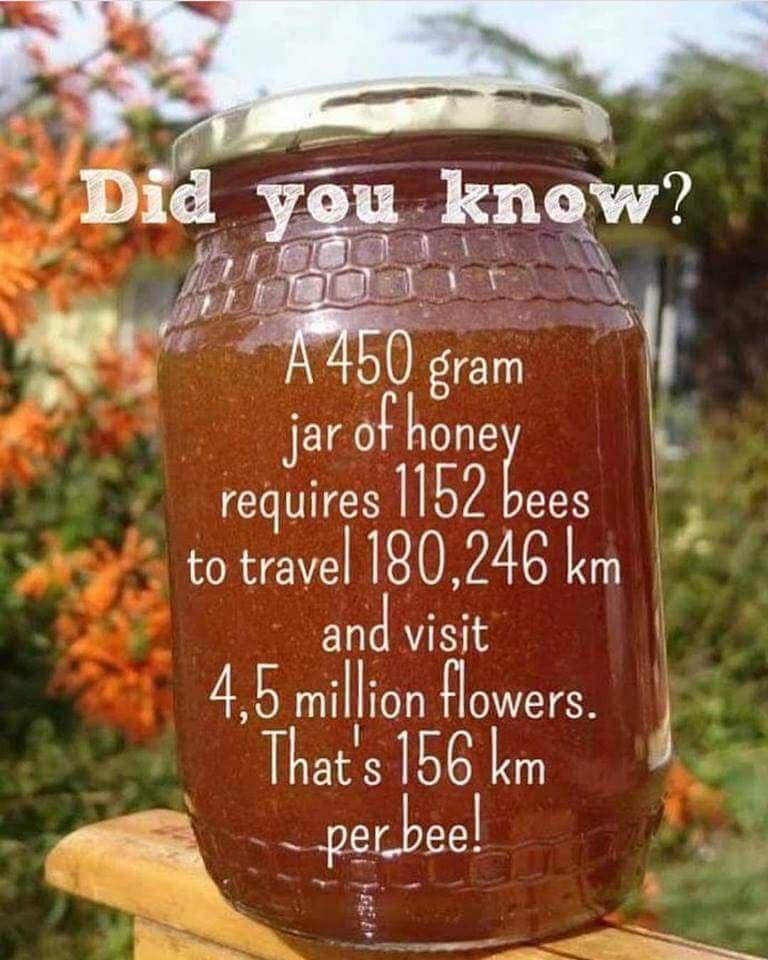
Honeybees make and eat their own honey. They do not (naturally) eat honey out of a jar bought from a supermarket: honey that has been produced by other honeybees, perhaps several thousands miles away: honey that has been heated, treated, processed and blended with corn syrup and other cheap sugars as profitable human commodity. Not only is this type of honey devoid of nutritional content, it will often contain pathogens of bee disease that are harmless to humans but disastrous – even fatal – to bees. Bee diseases that may be present in the country where that honey was made – but not (yet) a problem here, in the UK, where that honey is sold (but could begin to spread via bees and other pollinating insects stuffing themselves with cheap honey out out for them by well-intentioned but misinformed humans. For this simple reason, we avoid feeding honey to bees.
Which brings us back, full circle, to the opening point: what can we do, if we want to ‘help feed’ and/or ‘save’ the bees?!
The answer is really quite simple.
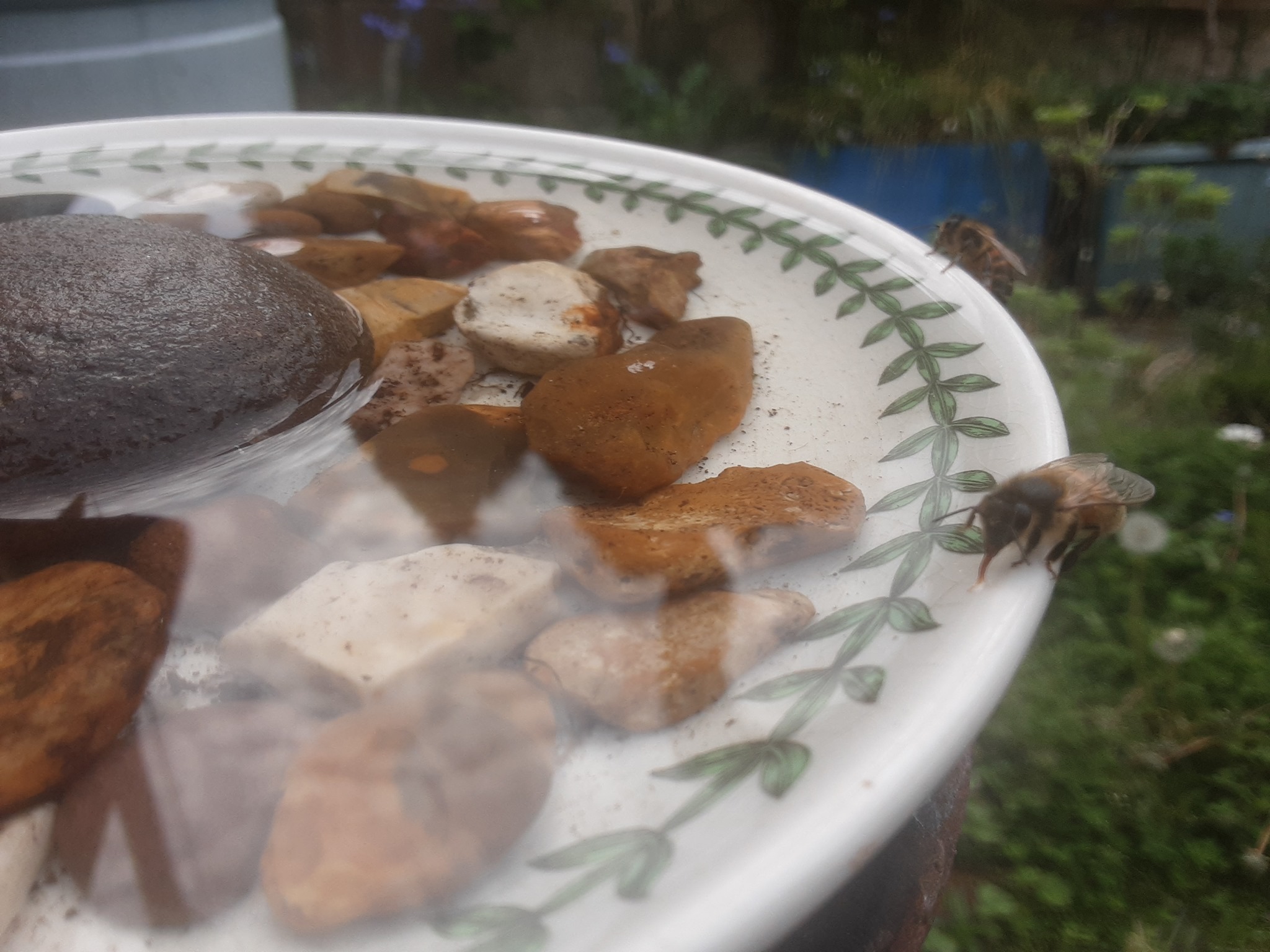
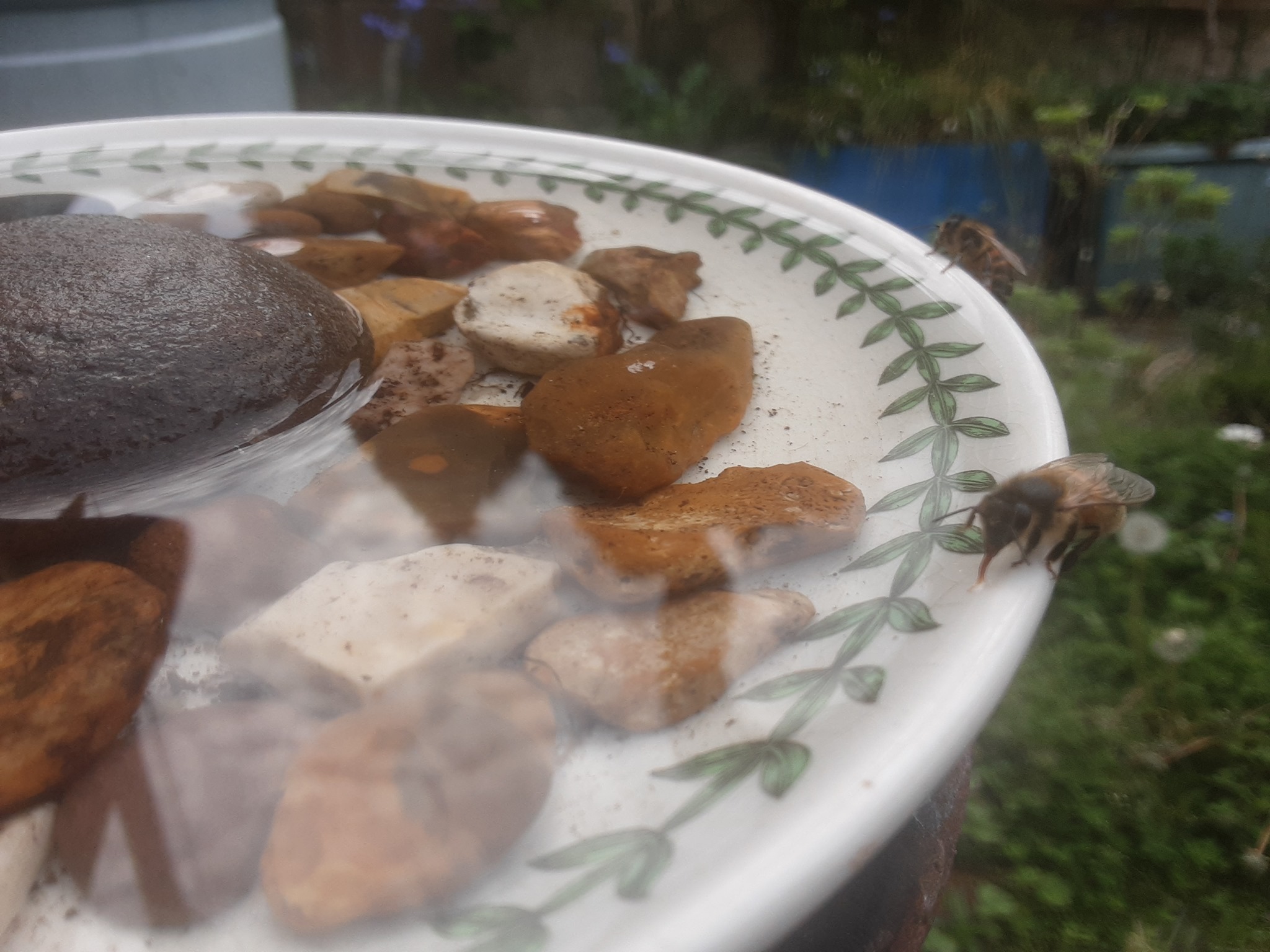
Firstly, yes, go ahead and create your ‘bee bar’. A shallow container, with a few pebbles, marbles or decorative stones (for the bees to stand on, so they do not drown). But please, no sugar water. No honey. And certainly no grated apple. Instead fill it simply with clean, fresh water. Honeybees take water back to the hive, to dilute their stored honey, ready for use. Other insects too will come for a drink. Add fresh water daily, and occasionally wash the container and also the stones (a quick rinse and scrub in clean water, to prevent algae and other build-up).
Second … and this is the BIG one, it should be first. Grow flowering plants. As wide range as possible, for as much of the year as you can. Bees (and other pollinating insects) forage on flowers: collecting nectar and pollen as food. However big or small your space – several acres of field, a modest back garden, a windowsill or a single small pot – this is, first and foremost, the most effective way to ‘help save’ the bees (and other pollinating insects).
‘I feel like a rat on a wheel. But the thing is – I built the wheel. This endless cycle of ‘to do’ … I created this … I put myself here … ‘
This realisation hit a couple of weeks back. I’d been feeling it for a while, but it took until now for those feelings to crystalise into thoughts expressed as words.
Living with so-called ‘invisible’ disability places limits on normal daily function. And because none of it is physically obvious – there is no wheelchair, no walking stick, no missing limb or prosthetic aid (hence the term *invisible* disability) the effects can be misconstrued as behavioural trait or personality fault. Lazy, unreliable, flaky (Yes, I’ve been called all of these and more. Mainly not to my face). The no.1 problem in all of is work. How to maintain a *normal* job in a no-longer-normally-functioning body? Hence my return to education in 2017 (embarking on an MA, which should have taken two years but, in reality, stretched out to more than three) – at this same time starting again with beekeeping (fifteen years on from my initial ‘dabble’) …
Skip forward three and a half years. MA completed (final mark pending) with various writing projects in process and the potential to continue on to a PhD this coming autumn. Health struggles are ongoing – exacerbated, of course, by the government-led Covid response (all ‘non essential’ hospital treatments – including my own rehabilitative therapies – were stopped last April/May, only recently restarting, after a year of non-intervention).
Meanwhile, on the beekeeping side, what started out as one hive has grown into several, across three different sites. Plus all of the associated activity (honey production, candle creation, hive maintenance). And then there’s the growing: flowers, herbs, veg … I’ve also, in this last 18 months, instigated and managed a community garden project in the street where I live (more of this another time, in a future blog post). As each new opening has arisen, I’ve gone with it. A fun-filled learning curve, at some point turned ‘rat on a wheel’. But here’s the thing: if it is me who put myself here, then it is me who can free myself back up. Reset the wheel.
This, then, is exactly what I am now doing. First up, the most obvious: reduce the physical work-load and time demands. Editing three apiary sites down into two. The choice (which one to let go?) has been easy: the Bee Garden, my very first apiary site, where I started out, back in 2018. Despite my best efforts, in nearly three years there’s never been a good honey harvest here: whole colonies have died (one of them quite suddenly) and/or struggled to survive overwinter, largely I think due to the adjacent farm fields (on all sides, stretching several miles, meaning insufficient wild forage and potential contamination with agro-chemicals). Add to this the land-owners plans to sell up in the near future, meaning I’ll have to be moving at some point anyway. As the saying goes, a ‘no brainer’. Nevertheless, I felt a considerable pang of sadness as I closed up the two hives, dismantled the hive-stand, loaded everything up and drove away for the last time – very soon overlaid with relief, as I settled them together into their new location at the Bee Field, which will now be my main apiary site.
Life is a constant process of change. We can resist – remain stuck – or go with it. Stagnate or adapt. Survive or thrive. The choice is our own.
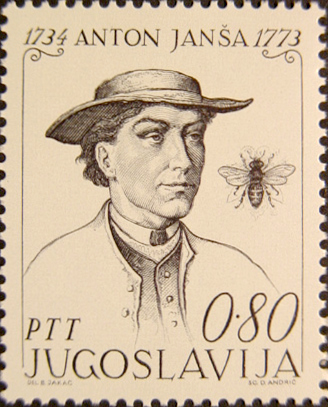
Today is World Bee Day. As a beekeeper, I did not know this. So I looked it up, and it turns out that World Bee Day came into existence only relatively recently, in December 2017, when the UN Member States approved Slovenia’s proposal to proclaim May 20th as just that: World Bee Day (the culmination of a three-year campaign by the Slovenian Beekeeper’s Association).
Why this date? Because 20th May (1734) is the birth date of Slovenian Apiarist Anton Jansa, a major pioneer in the world of beekeeping.
Again, I did not know this.
We do indeed live and learn.
So, what’s it all about? Well … bees … obviously. The aim being to raise awareness of the importance of bees and beekeeping around the world, through the celebration of World Bee Day. It should by now not come as news to any of us that we need bees. Not just honeybees, but all bees and also other pollinati’ insects. Our own survival – and that of everything else on the planet – depends on it. Simple as. The good news is, there is a LOT that we can do to help. And none of it is too difficult:
1) Provide pollinator food forage: ie: grow flowers. In your garden, on your allotment, in pots or in window boxes. As wide a variety as you can, and for as much of the year as possible – ideally, all year round.
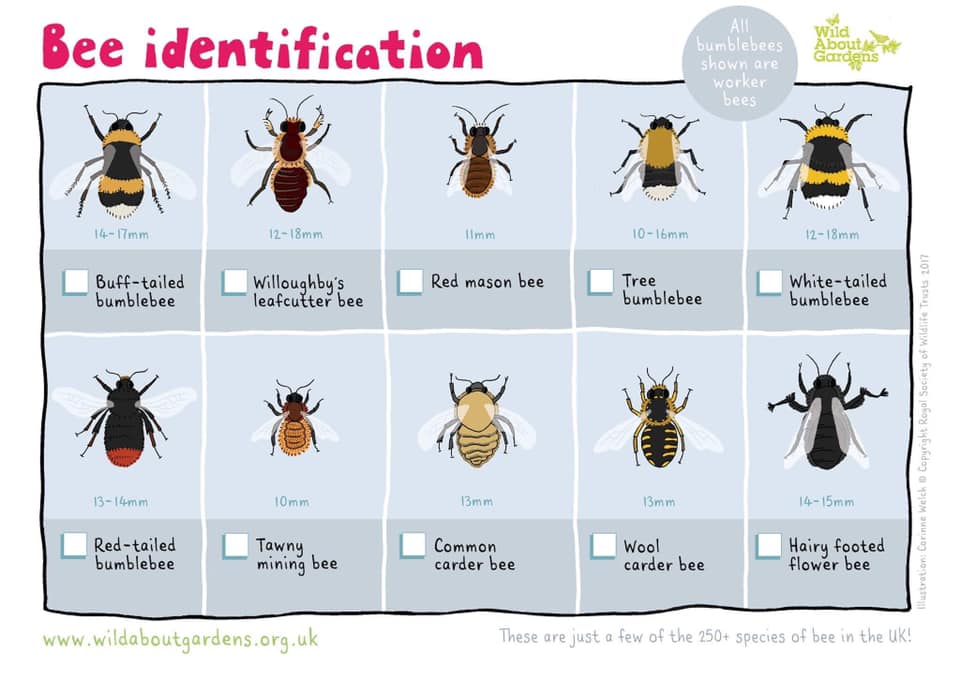
2) Get to know the many different types of bees. Watch them. Enjoy them.
3) Provide housing. No, this does not mean you need to take up beekeeping (unless, of course, you want to, and have the knowledge and practical means to do so). Honeybees live in beehives. Many other types of bee do not. An Insect Hotel will be a great home for solitary bees. And a pile of logs will provide a safe place for Bumblebee Queens and Solitary Bees to retreat overwinter.
4) Provide fresh drinking water. Nope, not sugar water. Not honey. Just clean, fresh water in a shallow dish, with marbles or pebbles to stand on while drinking, and as landing and/or take-off points.
5) Buy local honey, and beeswax products. Support your local beekeeper, helping them to support their bees. Most of the honey for sale in supermarkets is mass-produced by commercial beekeepers, treating their bees a economic commodity rather than living being. And much of this so-called ‘honey’ is heavily adulterated with cheap sugar syrups – meaning it’s not actually honey. Buy from your local small-scale beekeeper and you’ll be getting real honey, made by bees that have been well cared for.
Yesterday we buried the cat. What a sad sentence that is to write. At somewhere around seventeen years of age, Shooey the Wonder Cat was the last of a feline trio, central to our wider family life. His old ma, Twink, shuffled off this mortal coil several years back, having made it to not quite a decade, while the ginger ninja known as A cat Called Chicken survived well into his twenty-first year. The house feels eerily empty. And quiet.
I began writing this on 6 January. And here we are now, more than 3 months on. Time flies, even under normal circumstance. But this last 12 months, with the whole world being so … well, just plain weird … time feels kind of elastic, speeding up and slowing down and standing still, all at the same … erm … time. And then there’s been winter. I am never particularly great in these cold, dark months. Throw in lockdown and … it’s all been a bit much really. But with spring now well and truly ‘sprung’, I’m beginning to get back out there, reconnecting with the wider world, and finding ways to move forward. Which, for me, means growing stuff and playing with bees. Creative activities – as much as my dodgy hand allows. Maintaining (or trying to maintain) health. And writing.
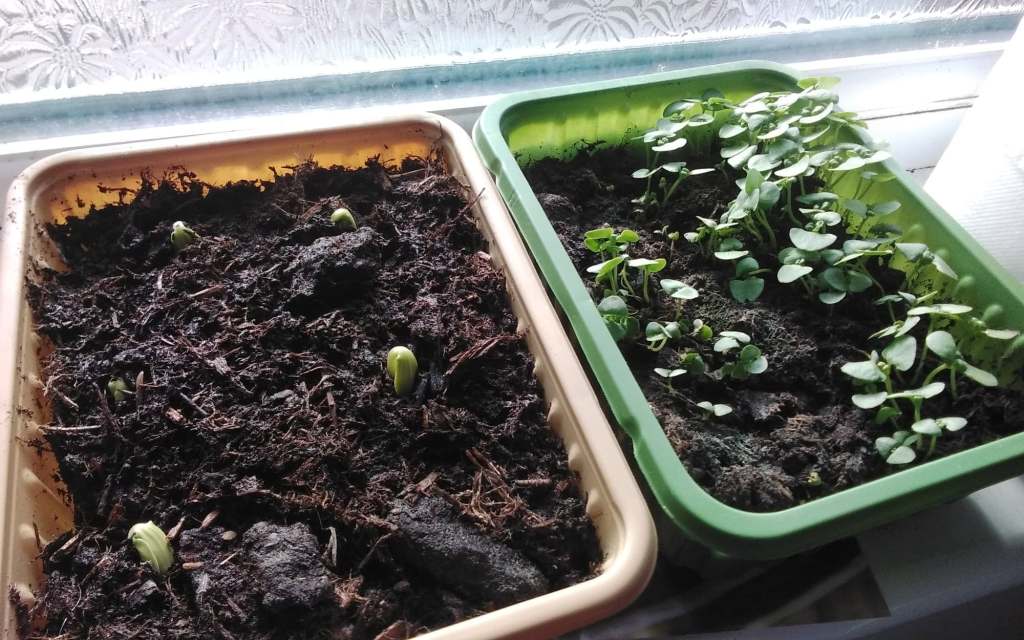
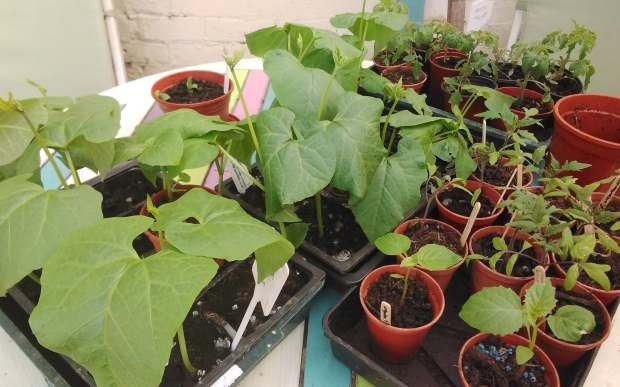
Having finally finished my MA in January (hoorah!) I’m allowing the academic side of my brain some much-needed ‘time off’. Yes, there are many projects to be pursued. But for now, I’ve been focussed on gentle reconnection with my garden and allotment. Which, at this time of year, means seed-sowing. Meaning every available space – from greenhouse shelf to windowsill – is crammed with trays and pots in various stages of growth, from newly-sown to awaiting-plant-out-to-final-growing-position. All very life-affirming.
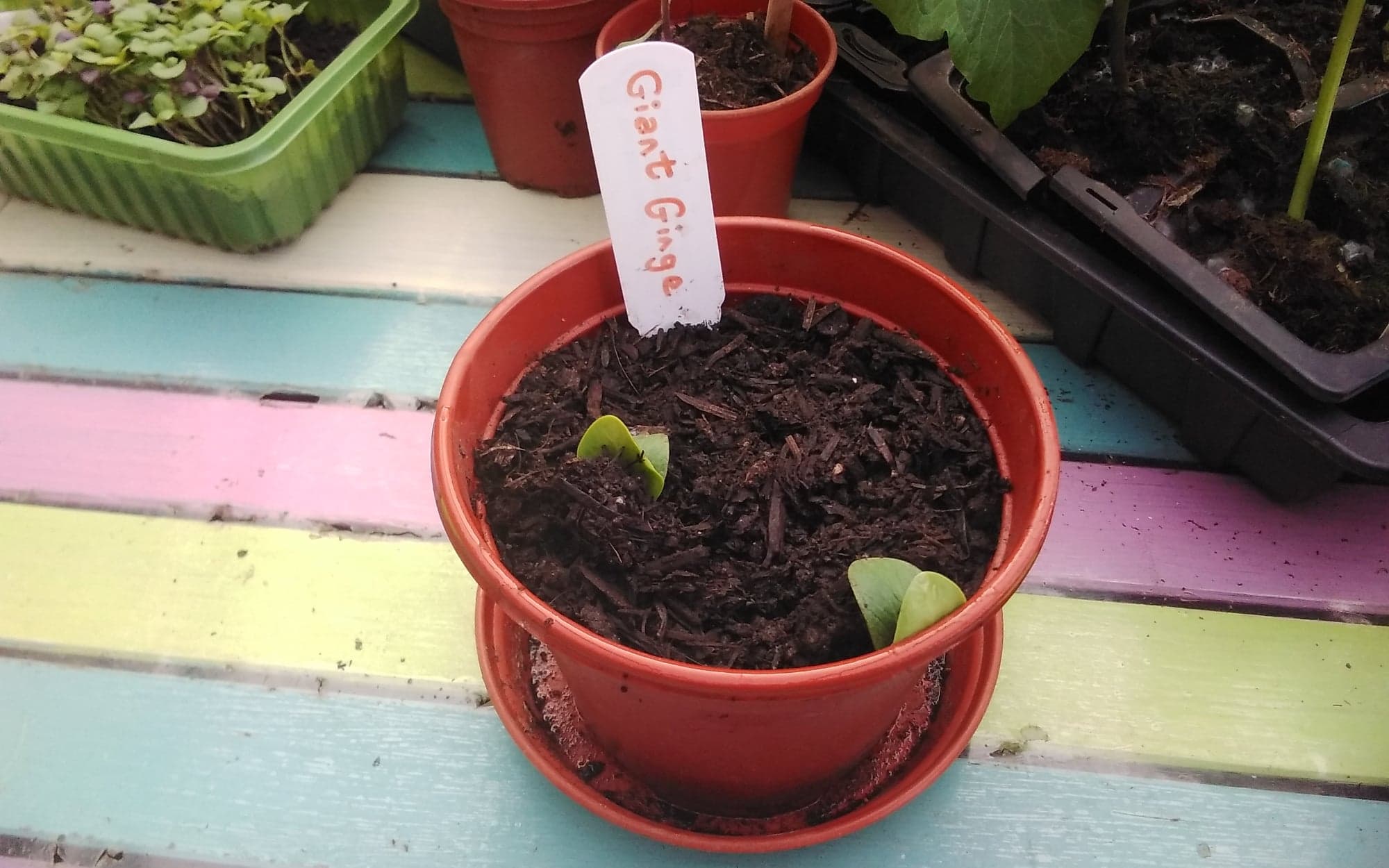
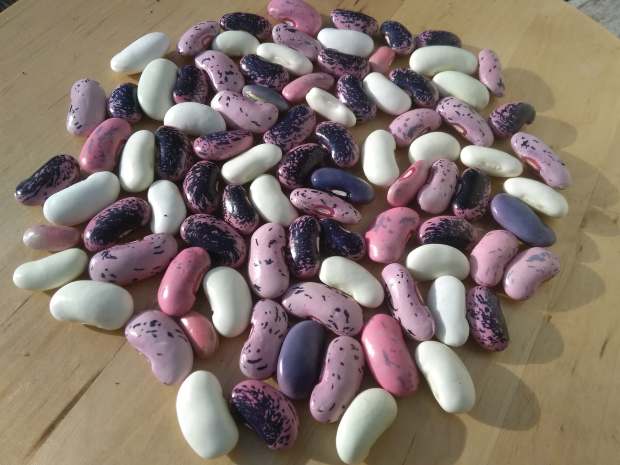
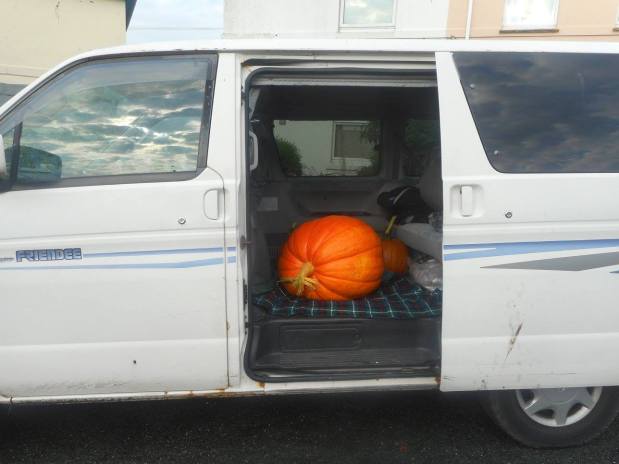
Even the hubby – a lifelong non-gardener – is getting in on the act, since a friend suggested a giant-pumpkin-growing competition via social media. Obviously he’s gone for the classic ‘Atlantic Giant’ – aiming to grow the best, and beat the rest. I myself meanwhile am on my usual mission to grow as many different types of beans as possible, using my own saved seed – from varying shades of climbing runner, borlotti and butterbean, along with all the other allotment plot ‘must haves’ – from squash to salad leaves to herbs and, of course, an array of flowers providing food forage for my bees.
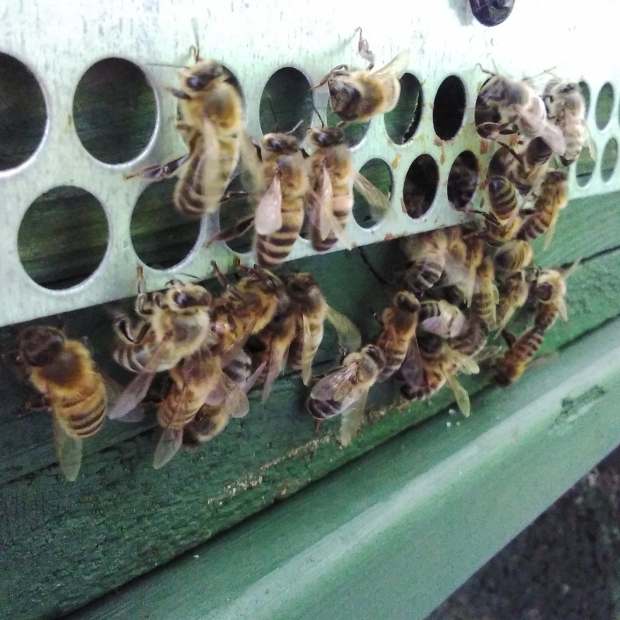
Of my six overwintered bee hive colonies, four have survived. I say this to people and they’re like: ‘Oh no! Two of your colonies died!?’ Missing the point, that a certain percentage loss is a *normal* part of beekeeping. Honeybee colonies in the wild die all the time … we just don’t see it. It’s just nature. It is just what happens. Survival of the fittest, and all that. Yes, it is disheartening to open a hive for that first spring inspection and find them all dead. Conversely, it is an absolute joy to find a hive alive and buzzing with life. Hope for the future. The promise of good things to come. And we all need a bit of that now, don’t we. It is early days yet, but all four surviving colonies are looking good as we head towards summer. All could go horribly wrong of course – spring-into-summer is still a precarious time, for honeybee survival rates. A sudden cold snap, insufficient food forage; things can turn in a moment. So we will see. Time will tell. But I’ll be doing my bit to keep them fed and nurtured, with a purpose grown bee buffet.
One other thing I’m particularly excited about is the future direction of this blogsite … I’m currently developing a ‘Shop’ link, enabling online purchase of my honey and candles alongside a range of other items, mainly sourced locally from independent creatives, each of them located ‘somewhere in west Cornwall’. So watch this space. Good things are coming …
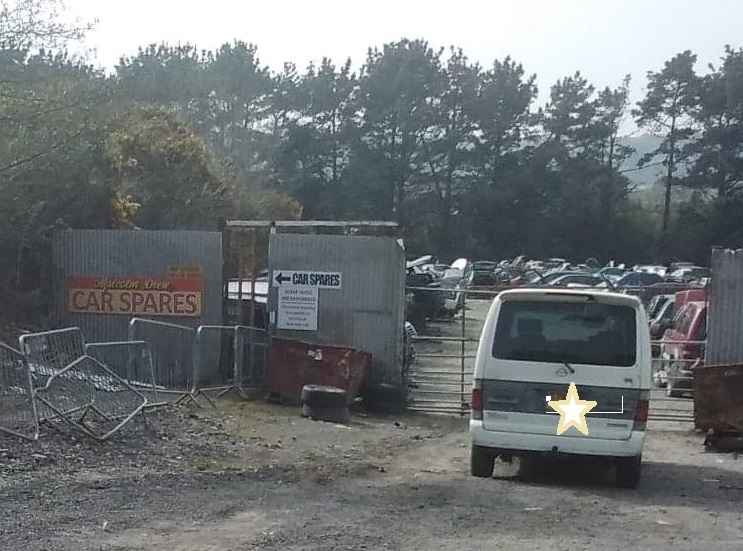
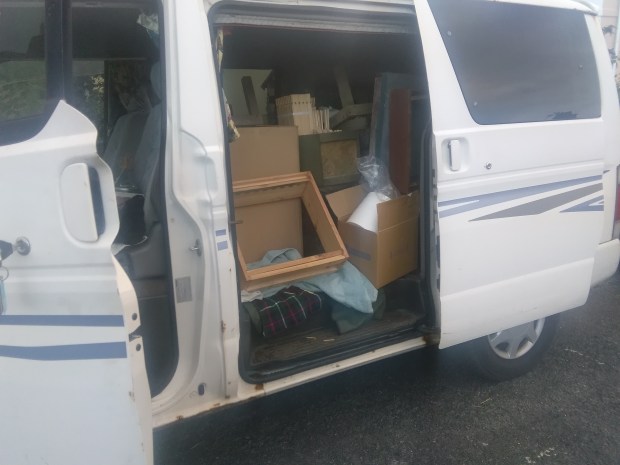
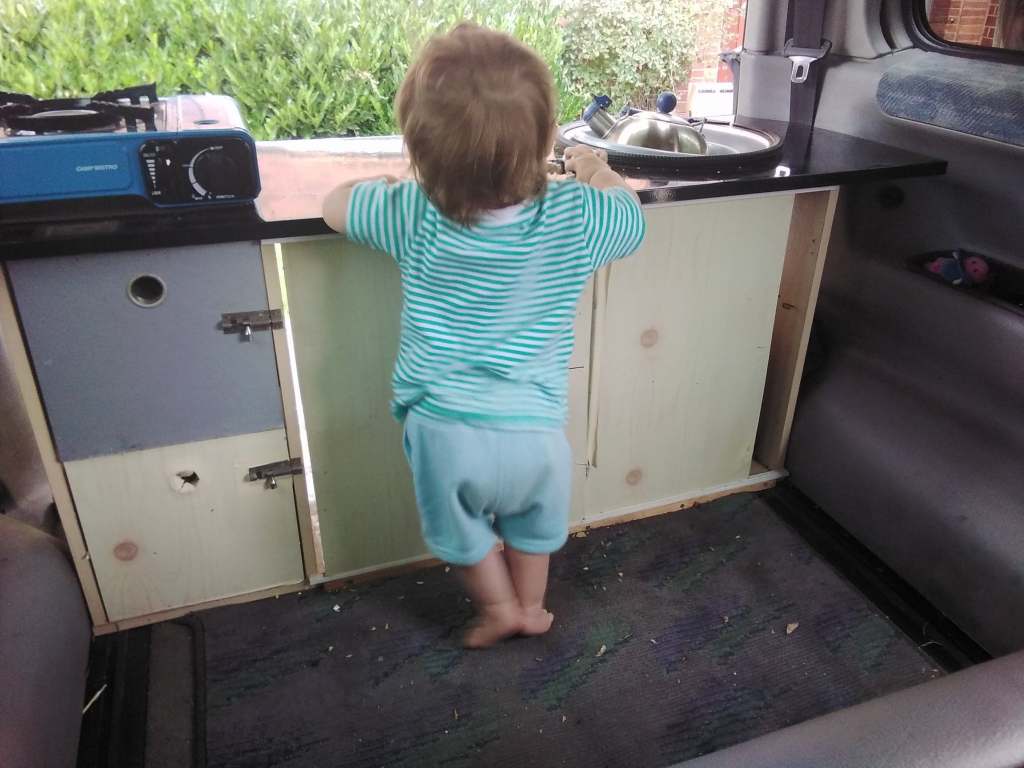
Oh, how we become attached to the vehicles in our life. Or is it just me?! Bongo Friendee. A friend indeedee. But when ‘repair’ becomes ‘rebuild’ you know it’s time to move on. I’ve never been one for naming my cars, and the van – my first van – the van – was no different. Always, simply, ‘the van’. We’ve had so much life in this van. So many adventures. So much fun. Quite a few sad times too. And as allotment and beekeeping runabout, it’s served me well. A real all-rounder, and a hard act to follow … But follow, something will. We’re just not sure what yet. Time will tell …
Two months in, and a belated ‘Happy New Year’ to all. What a year 2020 turned out to be. What will 2021 bring?! Time will tell. For me inevitably this coming year will involve bees. And flowering plants. And words. And various creative projects … all to be revealed. Watch this space for updates.

















 SomewhereinwestCornwall